
recent posts

Tags cloud
Obsolete Electronic Components and DMSMS: What Defense Procurement Teams Need to Know in 2026
DMSMS component obsolescence
A critical electronic component reaches the end of its production life. A manufacturer stops supporting a legacy product. A material becomes difficult to obtain. A supplier disappears from the market.
For most commercial organizations, these situations may create an inconvenience.
For a defense, aerospace, federal or scientific program expected to remain operational for years or even decades, they can create a much larger problem.
This is the challenge behind Diminishing Manufacturing Sources and Material Shortages, commonly known as DMSMS.
DMSMS describes situations in which manufacturers or suppliers of items, materials or software are lost or are expected to become unavailable. The Department of Defense treats DMSMS management as a lifecycle discipline because component obsolescence can affect cost, schedule, system availability, readiness and long term support.
In January 2026, the Defense Standardization Program updated its SD 22 DMSMS Guidebook, reinforcing the importance of proactively identifying and managing obsolescence throughout a system’s lifecycle.
For procurement teams, program managers, engineers and supply chain professionals, the lesson is straightforward:
Obsolescence should be managed before a critical component becomes impossible to obtain.
What Is DMSMS?
DMSMS stands for Diminishing Manufacturing Sources and Material Shortages.
A DMSMS issue can occur when a manufacturer or supplier stops producing or supporting an item that a system still requires.
The issue is not limited to semiconductors or electronic components.
DMSMS can affect:
Electronic components
Mechanical parts
Raw materials
Commercial hardware
Software
Operating systems
Specialized equipment
Support services
Manufacturing processes
The current Department of Defense SD 22 guidance describes DMSMS management as a multidisciplinary process used to identify obsolescence, loss of manufacturing sources and material shortages, evaluate their potential impact, analyze possible mitigation strategies and select an appropriate response.
That distinction is important.
DMSMS management is not simply about finding another supplier after something becomes unavailable.
Effective DMSMS management attempts to identify risk early enough that organizations still have options.
Why Defense Systems Are Especially Vulnerable to Obsolescence
The lifecycle of commercial technology can be remarkably short.
New processors, storage devices, networking equipment, operating systems and electronic components are introduced continuously. Manufacturers naturally shift production toward newer and more profitable products.
Defense and aerospace systems operate on a very different timeline.
A platform may need to remain operational long after many of its original components have disappeared from normal commercial distribution.
That creates a fundamental mismatch.
A component manufacturer may think in terms of a product lifecycle measured in several years.
A defense program may need to sustain equipment for several decades.
The longer a system remains in service, the greater the likelihood that some original components, materials, software or manufacturing processes will eventually become unavailable.
The Defense Standardization Program specifically recommends beginning DMSMS management early and continuing it throughout a system’s lifecycle.
What Can Cause a Component to Become Obsolete?
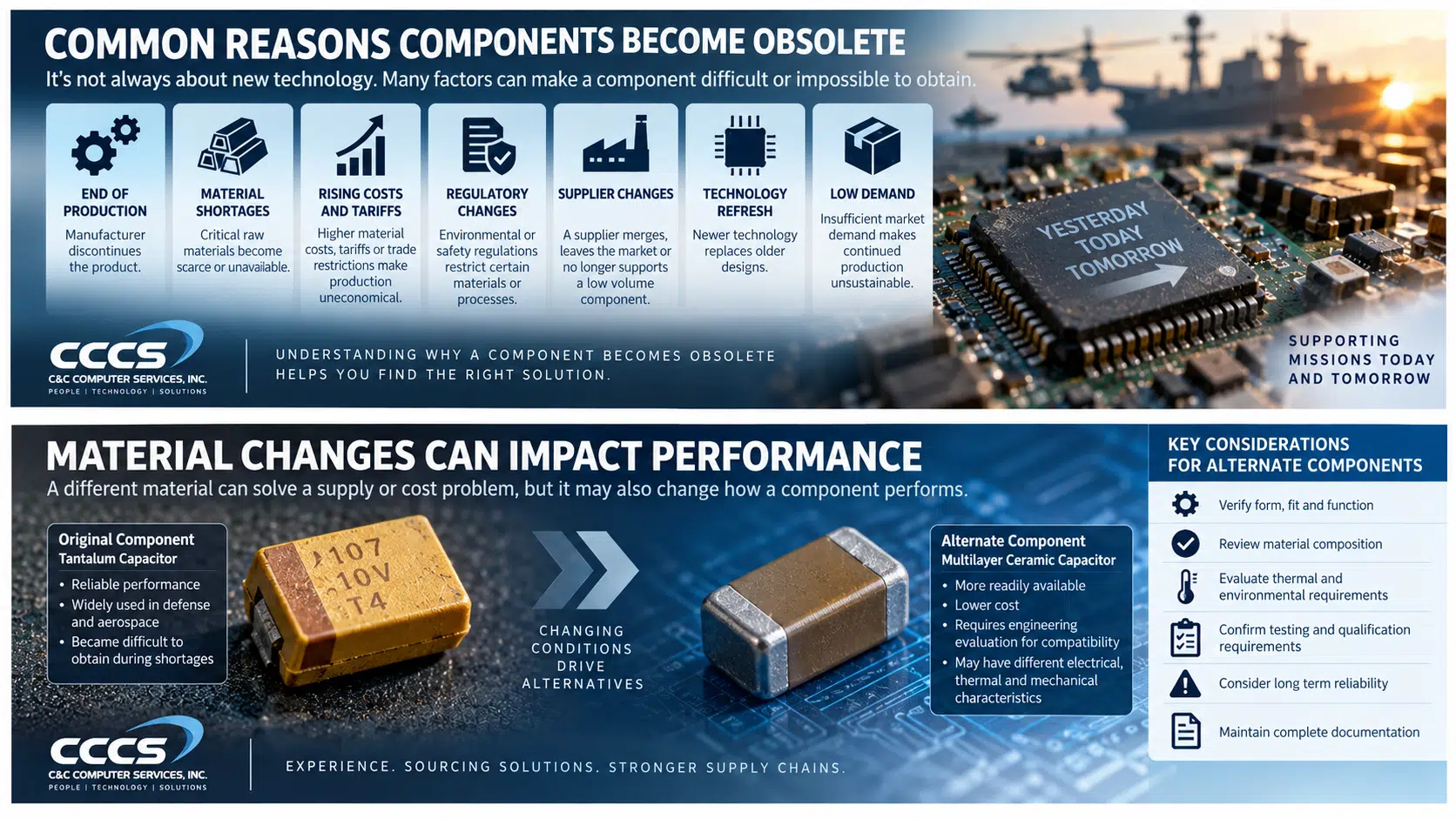
Obsolescence does not always occur because a newer or better technology has replaced an older component.
At CCCS, we have seen another important factor from the procurement side: sometimes the materials, economics or supply chain that made a product practical simply change.
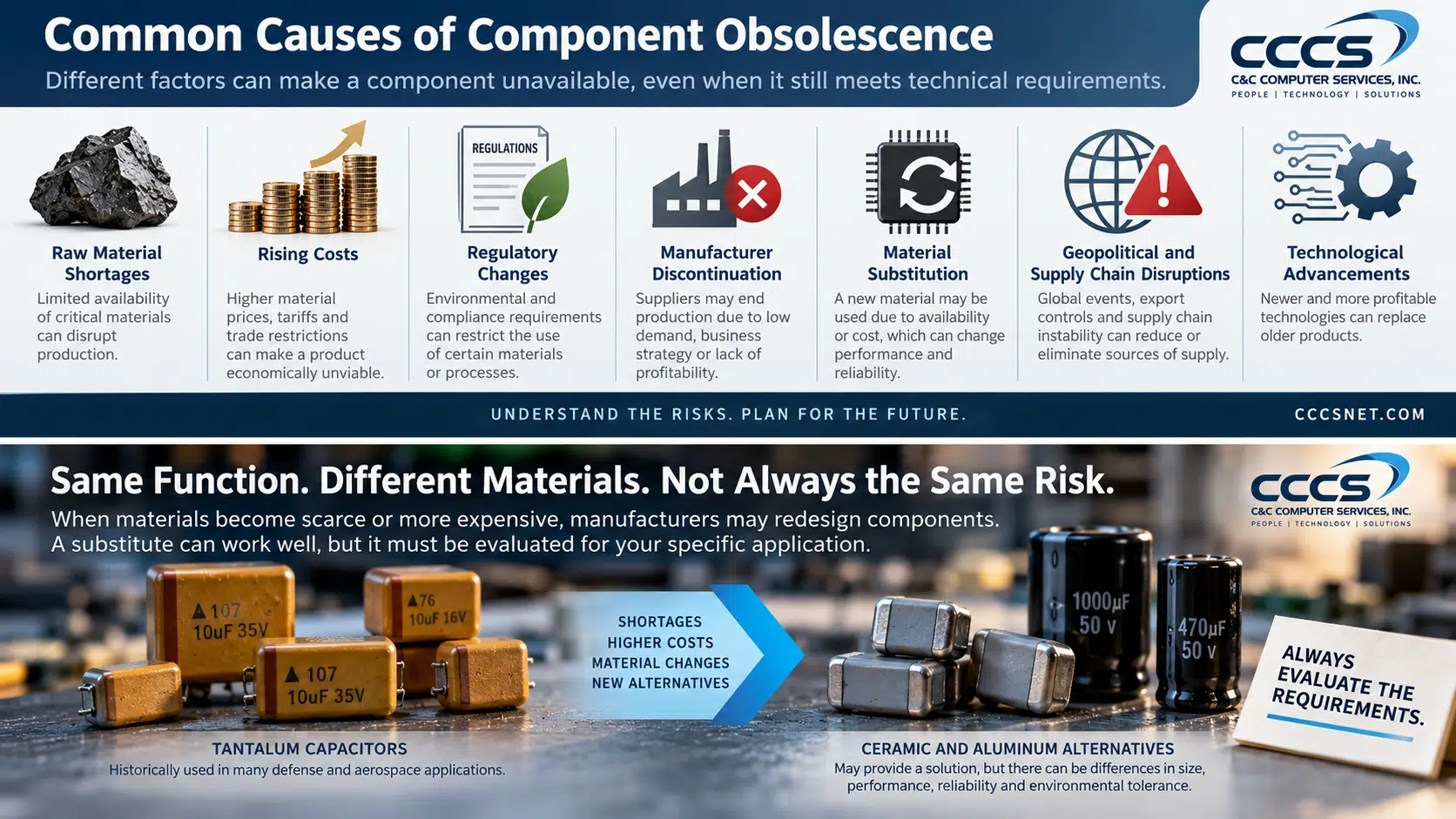
A shortage of a critical raw material can dramatically increase manufacturing costs. Tariffs, trade restrictions and export controls can change the economics of sourcing materials from particular regions. Commodity prices can rise. Environmental regulations can restrict materials that manufacturers have relied on for years. In other cases, a supplier may decide that continuing to manufacture a low volume component no longer makes financial sense.
Eventually, a manufacturer may have several choices. It can increase the price, redesign the product, substitute another material or discontinue the product entirely.
This is one reason procurement teams should not assume that a discontinued component disappeared simply because it became technologically outdated.
The Department of Defense recognizes this problem in its 2026 SD 22 DMSMS guidance. The guide identifies supply constrained materials, regulatory restrictions, materials that become difficult or prohibitively expensive to obtain, loss of tooling and situations where a supplier’s business case is no longer economically viable as potential causes of DMSMS issues.
Material Substitution Can Solve One Problem and Create Another
When the cost or availability of a material changes significantly, manufacturers often look for alternatives.
That does not automatically mean the replacement is inferior.
A properly engineered, tested and qualified substitute can perform as well as, or sometimes better than, the original material. Material innovation is an important part of manufacturing.
The concern arises when availability or cost pressures force changes that have not been fully evaluated for the intended application.
A replacement material can have different electrical characteristics, thermal behavior, corrosion resistance, mechanical strength, fatigue characteristics, storage requirements or long term reliability.
For a commercial product expected to operate for a few years under normal conditions, those differences may have little practical impact.
For a defense, aerospace or mission critical system that could remain in service for decades and experience vibration, temperature extremes, humidity, long storage periods or difficult operating environments, the same differences can become significant.
This is something CCCS believes procurement teams should keep in mind when evaluating alternate or replacement components. Finding something that fits is not necessarily the same as finding something that performs identically.
Example: Palladium Prices Changed How Capacitors Were Manufactured
A good example comes from multilayer ceramic capacitors.
TDK historically used palladium in capacitor electrodes. Around 2000 and 2001, the price of palladium increased dramatically. TDK reported that its average palladium price had been approximately ¥1,400 per gram and at one point climbed to roughly ¥4,000 per gram.
According to TDK, the increase created significant cost pressure, and the company transitioned almost entirely to base metal electrodes using nickel. At the time of its report, TDK stated that approximately 95 percent of its operations were already using nickel.
This is a useful example because the original material did not suddenly stop working.
The economics changed.
In this case, nickel became a successful engineered alternative. It demonstrates how raw material prices can cause manufacturers to change the fundamental construction of an electronic component even when the original design remains technically viable.
Example: Tantalum Shortages Forced Engineers to Find Alternatives
Tantalum capacitors provide another good example.
During the severe tantalum shortage around 2000, supplies became difficult to obtain and the price of tantalum powder increased substantially. Manufacturers and electronics companies began looking for alternatives because simply continuing to use the original component was becoming increasingly difficult.
Industry reports from the period describe engineers replacing some tantalum capacitors with high capacitance ceramic capacitors, aluminum electrolytic capacitors and other technologies. Manufacturers also investigated niobium as an alternative capacitor material.
The shortage did not mean that tantalum suddenly became a poor material.
The supply chain changed enough that engineers were forced to reconsider whether using tantalum continued to make sense for every application.
This is an important distinction in DMSMS management. Sometimes an alternative appears because it is technologically superior. At other times, innovation is accelerated because the existing material has become too expensive, difficult to obtain or risky to depend upon.
Example: Lead Free Electronics Show Why Qualification Matters
The transition from traditional tin lead materials to lead free electronics provides an important example of why material substitution must be evaluated carefully in high reliability environments.
Environmental regulations and global commercial market changes caused much of the electronics industry to move toward lead free solder and component finishes.
Commercial electronics manufacturers adapted accordingly.
Military and aerospace systems, however, presented different reliability requirements.
NASA and the Department of Defense studied the effects of lead free electronics because changes in materials and manufacturing processes could introduce issues including higher processing temperatures, material incompatibilities, reduced solder joint reliability and electrically conductive tin whiskers.
NASA has documented multiple system failures associated with tin whiskers, including failures in commercial satellites as well as reported problems involving military and other high reliability electronic systems.
This does not mean that lead free technology is inherently substandard.
It demonstrates something more important for procurement teams:
A material that is acceptable for one application may not automatically be suitable for another.
Changes that work well in high volume commercial electronics can require additional testing, mitigation or qualification before they are appropriate for equipment expected to operate for decades or under demanding environmental conditions.
A Current Example: Copper Costs Are Driving More Aluminum Substitution
The same economic pressure is visible today.
During 2026, sharply higher copper prices have encouraged manufacturers in several industries to increase their use of aluminum where engineering requirements allow it.
Reuters reported in June 2026 that automotive manufacturers, cable producers and HVAC manufacturers were increasingly evaluating or using aluminum because of its lower cost and lower weight compared with copper. Copper still offers superior electrical conductivity, so using aluminum can require different designs and engineering considerations.
Again, aluminum is not automatically a lower quality material.
The example demonstrates how quickly economics can influence engineering and sourcing decisions.
When the cost difference becomes large enough, manufacturers have a strong incentive to redesign products around a material that is more readily available or economically sustainable.
Why This Matters to Procurement Teams
From the CCCS procurement perspective, understanding why a component changed or disappeared can be just as important as locating a replacement.
If a product was discontinued because a critical material became scarce or prohibitively expensive, finding old inventory may solve today’s requirement without solving the longer term supply problem.
If a manufacturer changed materials, procurement and engineering teams may need to determine whether the newer version has the same characteristics required by the original application.
If an alternate component is available at a surprisingly low price when the original material is experiencing severe shortages or significant cost increases, that may also justify additional investigation into its source, construction and documentation.
For defense and mission critical applications, price and availability should therefore be considered alongside material composition, traceability, qualification, reliability and intended operating environment.
Sometimes the most important question is not simply:
“Can we find this component?”
It is:
“Why did the original component become difficult to obtain, and what changed in the alternatives now being offered?”
That question can reveal risks that are easy to miss when procurement decisions are based primarily on price and immediate availability.
What Changed in 2026?
DMSMS is not a new concept, but 2026 has brought renewed activity around the subject.
The Defense Standardization Program released an updated version of SD 22, Diminishing Manufacturing Sources and Material Shortages, on January 6, 2026. The guide provides current best practices for establishing and operating a DMSMS management program.
The Department of Defense also updated the DMSMS Management Plan data requirement in February 2026. That document focuses on contractor processes for identifying, forecasting and managing piece part obsolescence and associated mitigation efforts.
A related DMSMS Life Cycle Management Data requirement was also updated in February 2026. It addresses information such as bills of materials, DMSMS notifications, case information, health information, cost and budgeting information and mitigation data.
Additional DMSMS related documents were updated during 2026, including the DMSMS Health Assessment Report and Operations Transfer Plan.
For defense contractors and procurement organizations, these developments reinforce a broader principle:
Obsolescence management is part of lifecycle planning, not simply a purchasing problem that begins when inventory disappears.
What Happens When a Manufacturer Announces End of Life?
An end of life notice should trigger analysis rather than an automatic purchase.
The first question is not simply:
How many can we buy?
The better questions include:
How long must the system remain supported?
How many components are likely to be required during that period?
Is the current component still the preferred technical solution?
Are approved alternatives available?
Will an alternate component require testing or qualification?
Could a redesign eliminate several future obsolescence problems at once?
Is the available inventory coming from a trusted and traceable source?
What are the storage requirements and shelf life considerations?
Could future software changes make the existing component unusable even if sufficient inventory is purchased?
The correct response depends on the system, the component and the remaining support requirement.
Last Time Buy, Alternate Source or Redesign?
When a component becomes unavailable, there is rarely one universal solution.
Several approaches may be possible.
Life of Need Purchase
An organization may purchase enough remaining inventory to support anticipated requirements for the remainder of a system’s service life.
This can be appropriate when usage is predictable, trusted inventory remains available and a redesign would create unnecessary cost or technical risk.
However, buying inventory without accurate consumption estimates can create a different problem.
Too little inventory may simply delay the shortage.
Too much may leave an organization holding expensive components that are never used.
Approved Alternate Component
Another manufacturer may produce an equivalent or acceptable alternative.
This can be an attractive solution, but compatibility should never be assumed solely because two parts appear similar.
Form, fit, function, environmental requirements, reliability, electrical characteristics, software dependencies and qualification requirements may all need to be evaluated.
Repair, Refurbishment or Reclamation
For some equipment, continued support may be possible through repair programs, refurbishment or controlled recovery of components from equipment that is no longer operational.
These options require careful technical and quality controls.
New Source Development
A new manufacturer may sometimes be qualified to produce an item that is no longer available from the original source.
This can restore supply, but qualification requirements, tooling, documentation and economics must be considered.
Redesign
When an obsolete component creates significant long term risk, redesigning a board, assembly or system may become the most sustainable solution.
Redesign can be expensive and disruptive, but repeated efforts to locate disappearing components can ultimately become more costly than addressing the underlying design dependency.
The objective is not simply to find the fastest answer.
It is to select the response that best balances cost, technical performance, schedule, availability and remaining system life.
The Counterfeit Risk Increases as Legitimate Supply Disappears
Obsolescence can create another serious problem.
Counterfeit exposure.
When an active component is available through normal authorized channels, procurement teams generally have multiple sourcing options.
When production ends and legitimate inventory becomes scarce, buyers may be forced deeper into secondary markets.
That is where sourcing discipline becomes increasingly important.
Scarcity can create opportunities for:
Remarked components
Recovered components represented as new
Incorrect date codes
Altered documentation
Unknown storage history
Unverified manufacturers
Unauthorized substitutions
Parts with incomplete traceability
A component that looks correct may not necessarily have the history, reliability or authenticity required for a mission critical application.
This is why an obsolete part search cannot be evaluated solely on price and availability.
Source matters. Documentation matters. Traceability matters.
CCCS discussed related verification considerations in our guide, 7 Things Procurement Teams Should Verify Before Buying Mission Critical IT Hardware. Read the mission critical hardware procurement guide
Seven Practical Steps When a Critical Component Is Discontinued
When a required component becomes obsolete or difficult to obtain, procurement and technical teams can reduce risk by following a structured process.
1. Confirm the Manufacturer Status
Verify whether the product is truly discontinued, approaching end of life, temporarily constrained or simply unavailable through a particular distributor.
These situations require very different responses.
2. Determine the Remaining Requirement
Estimate how long the equipment must remain supported and how many units are realistically expected to be required.
Historical consumption data can help establish a reasonable forecast.
3. Review Approved Sources and Alternatives
Determine whether alternate manufacturers, approved substitutes or newer compatible products already exist.
4. Involve Engineering Before Accepting Substitutions
Procurement should not independently assume that a similar part is technically interchangeable.
Engineering review may be required to determine whether qualification, testing, software changes or documentation updates are necessary.
5. Evaluate the Source Carefully
As products become scarce, sourcing risk generally increases.
Supplier reputation, product provenance, traceability, inspection requirements and documentation should receive greater attention.
6. Consider the Entire Remaining Lifecycle
A purchase that solves today’s shortage may not solve next year’s support problem.
Consider future availability, repair requirements, software dependencies and other components in the same assembly that may also be approaching obsolescence.
7. Document the Decision
Maintain records of manufacturer notices, technical evaluations, approved alternatives, source information, traceability documentation and the reasoning behind major procurement decisions.
Good documentation helps future procurement teams understand why a decision was made and can reduce repeated investigation when the issue returns.
Bills of Materials Become Extremely Valuable
One of the most useful tools for proactive obsolescence management is a well maintained Bill of Materials.
A BOM allows an organization to identify the specific components on which a system depends and monitor their lifecycle status.
Without accurate component information, teams may not discover an obsolescence problem until they attempt to reorder a part.
With better visibility, organizations can identify risk earlier.
The 2026 DMSMS lifecycle data requirements specifically identify Bills of Materials, DMSMS notifications, case data, health information and mitigation information as data that may support DMSMS management activities.
For long life systems, maintaining accurate configuration and component information can turn an emergency sourcing problem into a manageable planning exercise.
DMSMS Is Also a Contracting Issue
DMSMS responsibilities may extend beyond the program office.
The Defense Standardization Program’s SD 26 DMSMS and Parts Management Contracting Guide provides guidance for establishing appropriate contract requirements.
The guide includes examples addressing DMSMS issue notification, case management, reporting and flow down of requirements to subcontractors.
That matters because visibility can disappear as the supply chain becomes more complex.
A prime contractor may depend on a subsystem supplier.
That supplier may depend on another manufacturer.
A critical component deep within the supply chain may be approaching obsolescence without the end customer being aware of the risk.
Clear responsibilities and reporting requirements can help surface these issues earlier.
Why Specialized Procurement Support Matters
Finding a current production server or networking device is very different from locating a component that disappeared from normal distribution years ago.
Legacy sourcing can require research across manufacturers, distributors, specialty suppliers, international sources and alternate products.
The objective should not simply be to locate someone willing to sell a part.
The objective is to find the right part from the right source with the documentation and confidence appropriate to the application.
At C&C Computer Services, Inc., our procurement capabilities include legacy support for hard to find and end of life components, electronic components, enterprise technology, custom sourcing and technical equipment.
Our role is to help customers navigate sourcing challenges and identify practical procurement options when conventional distribution channels no longer provide a simple answer.
Explore CCCS procurement and sourcing capabilities
Frequently Asked Questions About DMSMS and Component Obsolescence
What does DMSMS mean?
DMSMS stands for Diminishing Manufacturing Sources and Material Shortages. It describes the loss or impending loss of manufacturers or suppliers needed to support a system, including suppliers of components, materials and software.
Is DMSMS the same as component obsolescence?
Component obsolescence is one common cause of a DMSMS issue, but DMSMS is broader. It can also include material shortages, disappearing manufacturing capabilities, unsupported software and loss of suppliers.
What should a company do when an electronic component is discontinued?
First confirm the manufacturer’s status and determine the remaining lifecycle requirement. Then evaluate available inventory, approved alternatives, repair options, new sources or redesign strategies. Engineering and quality requirements should be considered before substitutions are accepted.
What is a last time buy?
A last time buy occurs when an organization purchases inventory before a manufacturer ends production. The quantity should normally be based on expected usage, remaining system life, repair requirements and other technical or storage considerations.
Why are obsolete electronic components more difficult to source safely?
As authorized inventory disappears, buyers may have to search secondary markets where traceability and storage history can be more difficult to establish. This makes supplier verification and documentation increasingly important.
Can an obsolete part simply be replaced with a newer component?
Not necessarily. Even when a newer component appears similar, engineering evaluation may be needed to verify compatibility, performance, environmental requirements, software dependencies and qualification requirements.
When should DMSMS planning begin?
Department of Defense guidance encourages proactive DMSMS management throughout the system lifecycle rather than waiting until a component becomes unavailable.
The Best Time to Address Obsolescence Is Before It Becomes an Emergency
Every long life technology system will eventually encounter change.
Manufacturers discontinue products.
Materials disappear.
Software reaches the end of support.
Supply chains evolve.
The organizations that manage these changes most successfully are usually not the ones that become best at reacting to emergencies.
They are the ones that identify risk early enough to maintain choices.
A proactive approach to DMSMS can give procurement, engineering and program management teams more time to evaluate alternatives, protect schedules, manage costs and reduce sourcing risk.
And when a difficult or obsolete component does need to be sourced, experience, supplier relationships and disciplined verification become increasingly important.
Need help locating hard to find electronics, legacy components or specialized technology?
C&C Computer Services, Inc. supports federal agencies, prime contractors and technical organizations with strategic procurement, legacy sourcing and mission critical technology requirements.
Contact CCCS about your procurement requirement
Sources and Further Reading
Defense Standardization Program, Diminishing Manufacturing Sources and Material Shortages resources. Defense Standardization Program DMSMS resources
Defense Logistics Agency ASSIST, SD 22 Diminishing Manufacturing Sources and Material Shortages. View the current SD 22 record
Defense Logistics Agency ASSIST, DMSMS Management Plan. View the current DMSMS Management Plan record
Defense Logistics Agency ASSIST, SD 26 DMSMS and Parts Management Contracting Guide. View the current SD 26 record
This article provides general information about technology procurement and publicly available Department of Defense guidance. Specific contractual, engineering, quality and compliance requirements may vary by program and application.
[/fusion_text][/fusion_builder_column][/fusion_builder_row][/fusion_builder_container]


